
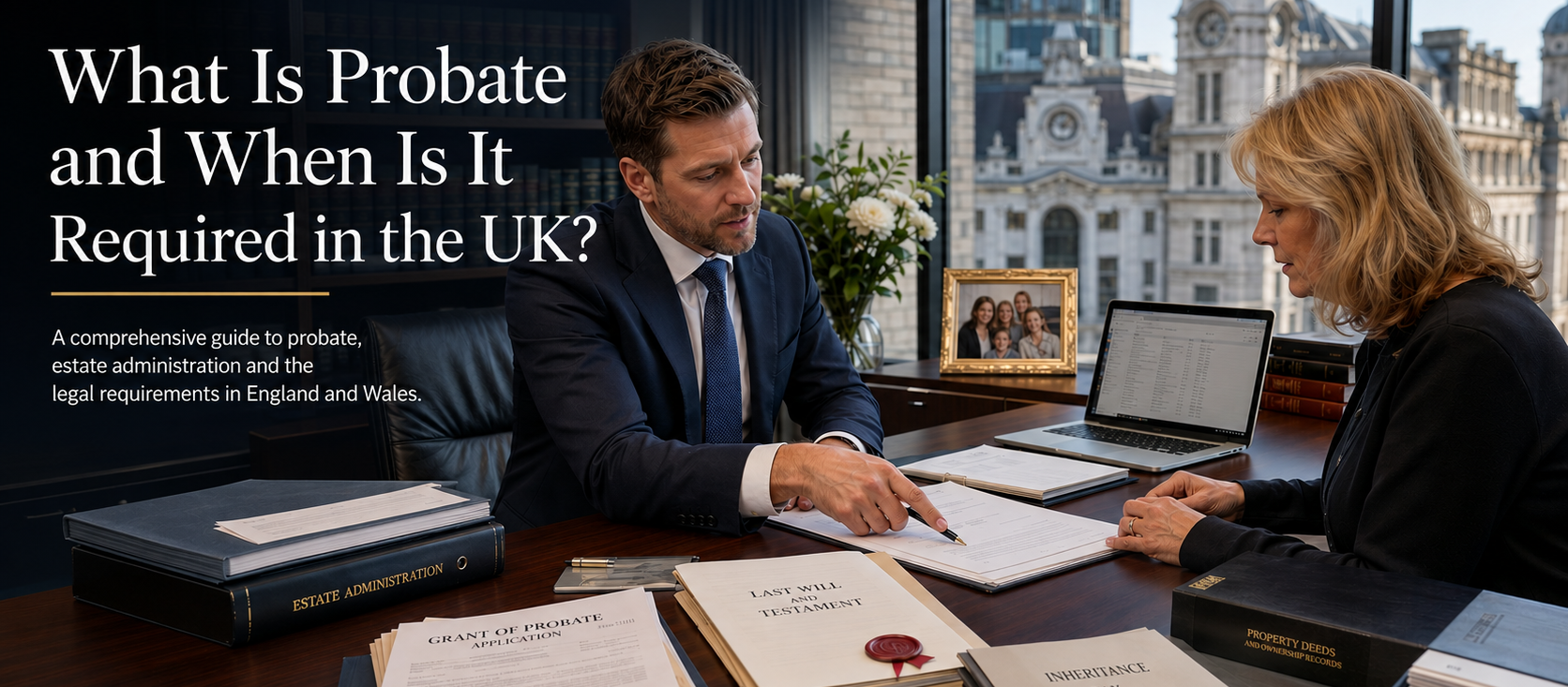
When someone passes away, their family and loved ones are often left not only grieving but also facing a range of practical and legal responsibilities. One of the most common legal processes that arises after a death in England and Wales is probate. Many people have heard the term but are unsure exactly what it means, when it applies, or how to navigate it. This guide aims to explain probate in plain English, helping you understand what to expect and when professional legal support may be needed.
What Is Probate?
Probate is the legal process by which a deceased person’s estate — their property, money, and possessions — is administered and distributed after their death. The word itself comes from the Latin probatum, meaning “to prove,” and refers to the process of proving that a will is valid and that the person dealing with the estate has the legal authority to do so.
In practical terms, probate gives the executor named in a will (or an administrator if there is no will) the legal authority to collect the deceased’s assets, pay any outstanding debts and taxes, and distribute what remains to the beneficiaries. Without this authority, banks, financial institutions, and other organisations will generally refuse to release funds or transfer assets.
The document that grants this legal authority is known as a Grant of Probate where there is a valid will, or Letters of Administration where there is no will (known as dying “intestate”). Together, these are referred to as a Grant of Representation.
When Is Probate Required?
Not every estate requires probate. Whether it is needed depends largely on what assets the deceased owned and how those assets were held. There is no fixed legal threshold in England and Wales that automatically triggers the requirement for probate, but the following situations commonly make it necessary.
Probate is typically required when the deceased owned property or land in their sole name. Most banks and mortgage lenders will not allow property to be sold or transferred without sight of a Grant of Representation. Similarly, if the deceased held significant sums of money in bank accounts held solely in their name, most banks will require probate before releasing those funds — though individual banks set their own thresholds, which can vary considerably.
Probate is also usually needed if the deceased held stocks, shares, or investments in their sole name, had outstanding debts or tax liabilities that need formal resolution, or if there are disputes among beneficiaries about how the estate should be divided.
When Is Probate Not Required?
There are circumstances where probate may not be necessary. If the estate is relatively small and consists mainly of cash and personal possessions, it may be possible to deal with matters without obtaining a Grant of Representation. Some banks will release modest sums — sometimes up to £10,000 to £50,000, depending on their own policies — on production of the death certificate and other documentation alone.
Assets that are held in joint names typically pass automatically to the surviving owner by a legal principle known as the right of survivorship. This is common with jointly owned property or joint bank accounts. In these cases, the asset simply transfers to the survivor without the need for probate, although you should check whether the property was held as joint tenants or tenants in common, as this affects the outcome.
Certain assets also fall outside of the estate entirely and are not subject to probate. These include life insurance policies written in trust, pension death benefits (as these are paid at the discretion of the pension trustees), and assets held in a trust. At Nazir Solicitors, we regularly advise clients on how proper estate planning — including the use of trusts and jointly held assets — can simplify the administration process for those left behind.
How Does the Probate Process Work?
The probate process in England and Wales involves several key steps. First, the executor or administrator must gather information about all of the deceased’s assets and liabilities. This involves contacting banks, financial institutions, the Land Registry, HMRC, and any other relevant organisations to establish the full picture of the estate.
Next, any Inheritance Tax (IHT) liability must be calculated and reported to HMRC, even if no tax is ultimately due. The current Inheritance Tax threshold (known as the nil-rate band) is £325,000, with additional allowances potentially available — such as the Residence Nil Rate Band of up to £175,000 where a home is left to direct descendants. Any IHT due must generally be paid before the Grant of Probate will be issued.
Once the Inheritance Tax position is resolved, the executor applies to the Probate Registry (part of HM Courts and Tribunals Service) for the Grant of Probate. This involves submitting a probate application, a copy of the will (if there is one), a death certificate, and the relevant IHT forms. Once granted, the executor uses the Grant to collect assets, settle debts, and distribute the estate to beneficiaries in accordance with the will or the rules of intestacy.
What Happens If There Is No Will?
If a person dies without a valid will, they are said to have died intestate. In this case, the estate is distributed according to the Rules of Intestacy set out in the Administration of Estates Act 1925 (as amended). These rules follow a strict legal hierarchy — prioritising spouses and civil partners, then children, then other relatives — and may not reflect what the deceased would have wanted.
Dying without a will can create significant complications. Unmarried partners, for example, have no automatic right to inherit under the intestacy rules, regardless of how long they lived together. Friends and charities are similarly excluded. In these situations, obtaining Letters of Administration is required, and the process can be more complex and emotionally difficult for families.
This is why making a valid will is so important. At Nazir Solicitors, we strongly encourage individuals of all ages to put a will in place to ensure their wishes are respected and to make the process as straightforward as possible for those they leave behind.
How Long Does Probate Take?
The length of the probate process varies depending on the complexity of the estate. A straightforward estate with a clear will, limited assets, and no Inheritance Tax liability might be resolved within three to six months. However, more complex estates — particularly those involving property, business interests, overseas assets, disputes, or significant tax issues — can take considerably longer, sometimes over a year.
Delays can also arise due to backlogs at the Probate Registry, difficulties tracing assets or beneficiaries, and complications with HMRC. Having experienced legal support can help to manage these challenges effectively and keep the process moving forward where possible.
Practical Tips for Dealing with Probate
- Register the death promptly — you will need multiple certified copies of the death certificate to send to various institutions.
- Locate the original will — check at home, with solicitors, or at a will storage service. Banks and the Probate Registry will require the original document.
- Make a full list of assets and debts — contact all financial institutions, the Land Registry, and relevant government departments to build a complete picture of the estate.
- Do not distribute the estate too early — wait until you are certain all debts, taxes, and claims have been settled. Executors can be held personally liable for distributing assets prematurely.
- Be aware of the six-month rule — potential claimants under the Inheritance (Provision for Family and Dependants) Act 1975 generally have six months from the Grant of Probate to make a claim, so caution is advisable during this period.
- Keep detailed records — document all decisions and transactions throughout the administration process to protect yourself as an executor.
- Seek professional advice early — particularly where Inheritance Tax is involved, the estate is complex, or where family disputes are likely.
How Nazir Solicitors Can Help
Dealing with probate during what is already a difficult time can feel overwhelming. At Nazir Solicitors, our experienced Wills, Trusts and Probate team is here to guide you through every stage of the process with sensitivity, efficiency, and expert legal knowledge. Whether you need help applying for a Grant of Probate, advice on Inheritance Tax, support with estate administration, or guidance on what to do when there is no will, we are here to help.
Nazir Solicitors acts for clients across South Yorkshire and beyond. We offer clear, practical advice tailored to your specific circumstances, so you can have confidence that the estate is being administered correctly and in accordance with the law.
If you have recently been bereaved or are acting as an executor and are unsure where to begin, contact Nazir Solicitors today for a friendly, no-obligation discussion. You can reach us by telephone or through our website, and we will be happy to explain how we can assist you every step of the way.
Contact Nazir Solicitors today to arrange a consultation with one of our Wills, Trusts & Probate specialists. You can reach us by telephone, email, or by visiting our office in Sheffield. We look forward to helping you protect what matters most.
Disclaimer: This article is intended for general information purposes only and does not constitute legal advice. The law relating to commercial property in England and Wales is complex and can change. Every transaction is different and the information in this guide may not apply to your specific circumstances. You should always seek independent professional legal advice before taking any action in relation to a commercial property transaction. Nazir Solicitors is a trading name of Affinity Seven Law Solicitors Ltd authorised and regulated by the Solicitors Regulation Authority (SRA No. 630144).
BOOK AN APPOINTMENT TODAY WITH MOHAMMED NAZIR
Tel: 0114 308 2727
Email: nazir@nazirsolicitors.co.uk